

The Overlit Portrait Problem, and How Film Solves ItBusiness & Marketing in Vancouver · Extenso Studio
Here is the mistake we see most often before a brand calls us: someone hired a photographer who lit the subject like a passport photo, retouched every pore into oblivion, and called it “premium.” The result looks expensive and says nothing. Audiences in Metro Vancouver, and honestly everywhere, have gotten very good at spotting that kind of portrait and scrolling past it in under a second.
The three-point lighting trap
Traditional three-point lighting was built for one job: eliminate shadow, eliminate mystery, eliminate anything that might read as human. That works for a driver’s license. It does not work when you are trying to convince someone your founder is trustworthy or your product is made by real hands. If we can describe your lighting setup in one flat sentence, your audience can feel it in one flat glance.

Our fix is almost embarrassingly simple: we mix aesthetic studio lighting with whatever natural sunlight is already spilling into the space, usually in a rough 60/40 ratio favouring the window. That imbalance creates the falloff, the warmth on one cheek and shadow on the other, that makes a face look like it belongs to a person instead of a brand deck.
Why we still shoot 35mm film for this work
Digital sensors are extraordinary at capturing detail. That is exactly the problem for portraiture meant to feel intimate. Too much resolution and too much dynamic range flattens emotion into information. Kodak Portra 400 does the opposite. It rounds off highlights, holds skin tone with a warmth no digital preset fully replicates, and adds a grain structure that reads as memory rather than marketing.

We are not shooting film for nostalgia points. We are shooting it because a 9:16 portrait meant to stop a scroll on Instagram or fill a hero banner needs to feel like a moment someone happened to witness, not a moment that was engineered for them. Grain does the same job a slightly imperfect brushstroke does in painting. It tells the viewer’s brain: this is real, relax.

The unposed rule we actually enforce
Here is our working rule on set at Extenso Studio: if a subject has held a pose for longer than four or five seconds, we already lost it. We shoot in bursts around movement, a laugh cut short, a hand adjusting a collar, someone glancing past the lens because something in the room actually caught their attention. Ninety percent of the frames we keep were never “the shot” the subject thought they were making. They were the shot right before or right after it.
This matters more for commercial and editorial work than people expect. A polished, posed portrait tells a viewer what to think of the brand. A raw, half-caught one lets the viewer decide the brand is worth trusting, because it looks like they were let in on something rather than sold something.
- Mistake we fix constantly: lighting a face to remove all shadow instead of using shadow to add dimension.
- Rule of thumb: if the pose lasted more than five seconds, it is probably not the frame.
- Why film still matters: Portra’s grain and colour science read as authentic in a market saturated with over-sharpened digital portraits.
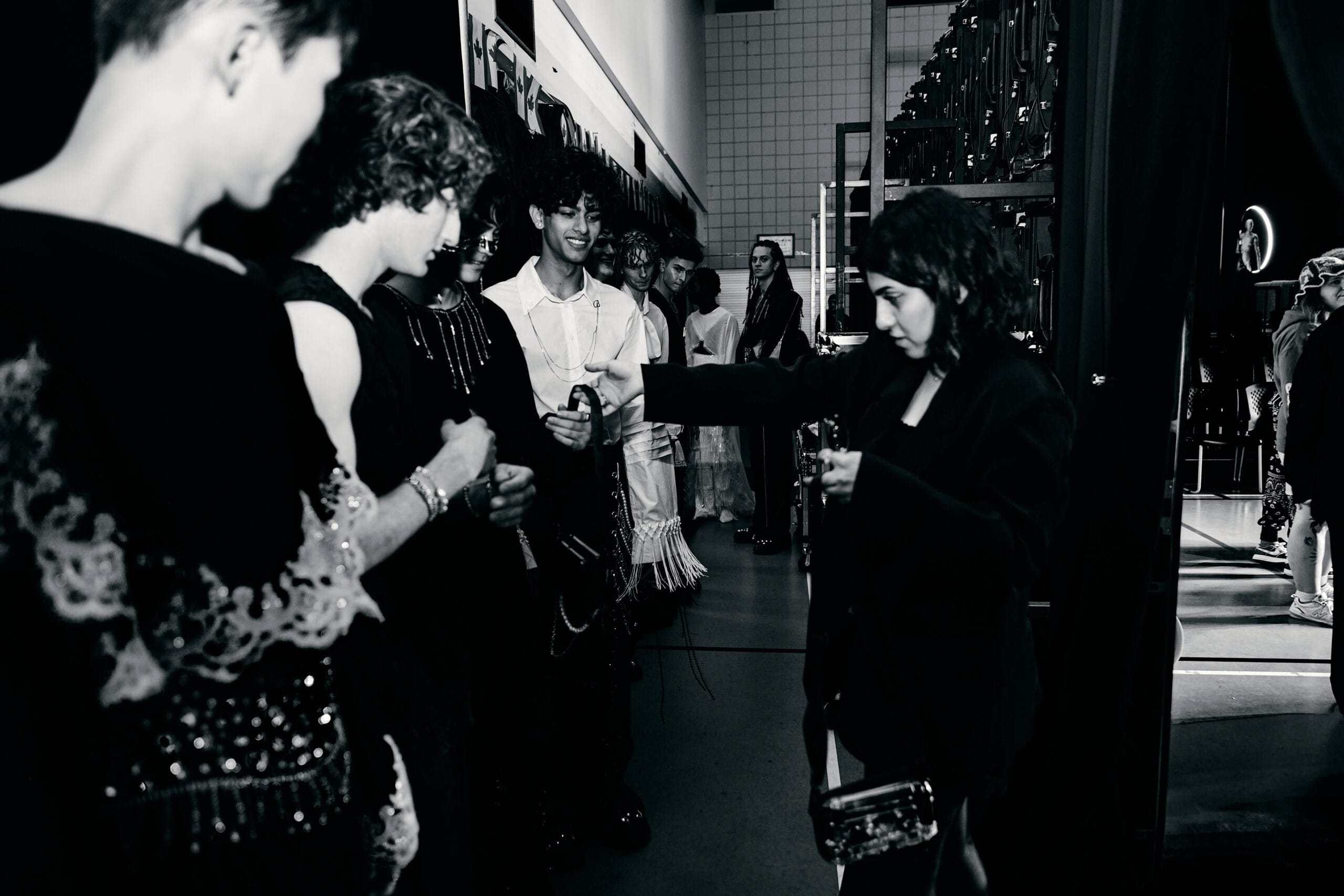
“Perfectionism.” Every strap and chain secured before the lights go up.

If your last shoot came back looking like everyone else’s LinkedIn banner, we would love to talk about what a moodier, more honest approach could do for your next one.
